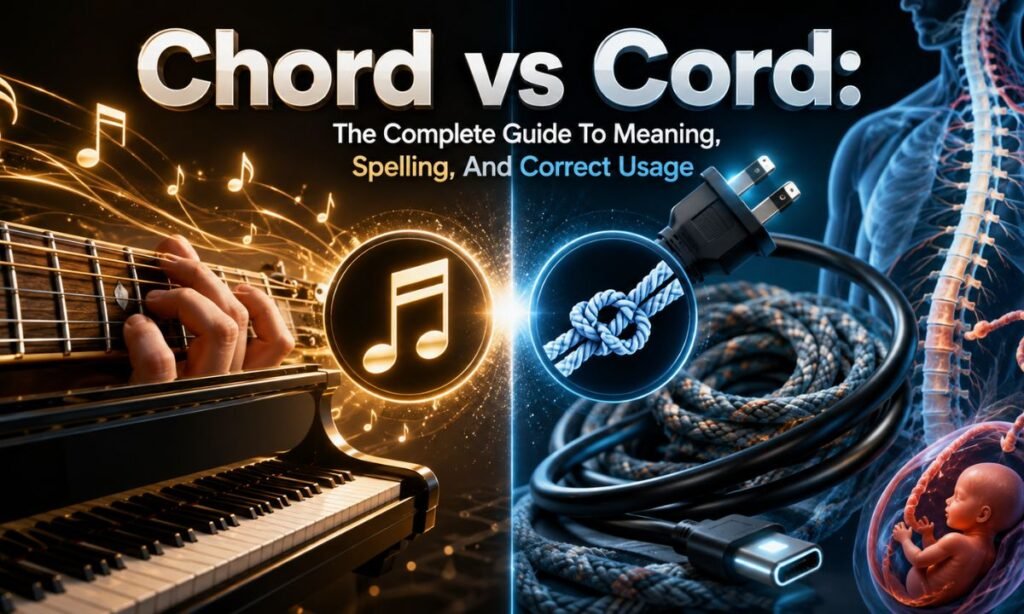
If you have ever paused mid-sentence, wondering whether to write “struck a chord” or “struck a cord,” you are far from alone. Chord and cord are two of the most commonly confused word pairs in English because they sound identical but mean completely different things. This guide breaks down exactly when to use each word, explains why the confusion occurs, and illustrates how the terms are used in music, biology, and everyday language.
Quick answer: A chord is a group of musical notes played together, or a mathematical line segment. A cord is a length of rope, cable, or string, and it is also the correct spelling for anatomical structures like the spinal cord and umbilical cord.
Chord vs Cord: Quick Definition Box
| Term | Core Meaning | Common Examples |
| Chord | Musical notes played together; a straight line joining two points on a curve | Guitar chord, piano chord, chord progression |
| Cord | A thin rope, string, or cable; also certain body structures | Extension cord, spinal cord, umbilical cord, vocal cords |
Why Chord and Cord Get Confused So Often
Chord and cord are what linguists call homophones: words that sound exactly the same but differ in spelling and meaning. English has thousands of these pairs (think “there” and “their”), and they trip up even experienced writers because spelling isn’t guided by sound alone. Both words trace back to different root origins, which is part of why the spellings diverged even though pronunciation stayed identical over centuries.
Pronunciation: Both words are pronounced the same way in standard American English: /kɔːrd/, rhyming with “board” or “sword.” There is no difference in how you say them out loud, which is exactly why mixing them up in writing is so easy.
What Does Chord Mean?
A chord has two distinct definitions depending on the field: music and mathematics.
Chord in Music
In music theory, a chord is a combination of three or more notes played at the same time to create harmony. Chords are the building blocks of songs, and understanding how they connect (called a chord progression) is fundamental to playing guitar, piano, or nearly any instrument.
Common Guitar Chords Beginners Learn First
- G chord: A bright, full-sounding open chord often used as a first chord for beginners.
- C chord: One of the most common open chords in popular music.
- D chord: A simple three finger shape frequently paired with G and C.
- A minor chord: The relative minor of C, easy to form and very common.
- F chord: Often considered difficult for beginners because it typically requires a barre.
- B chord and Bm chord: Barre chords that build finger strength and are usually introduced after open chords.
- B7 chord and F#m chord: Extended and minor variations used to add color to progressions.
Note Box: A chord progression is simply a sequence of chords played in a specific order, such as G, C, D, and Em, which forms the backbone of thousands of popular songs. Many guitarists use a chord progression generator or a printed guitar chord chart to explore new combinations quickly.
Chord Overstreet, an American singer and actor, shares his surname with the musical term, but his name is unrelated to the word’s musical meaning; it is simply a family name.
Chord in Mathematics
In geometry, a chord is a straight line segment whose endpoints both lie on a curve, most commonly a circle. Unlike a diameter, a chord does not need to pass through the center of the circle. This definition is taught in basic geometry courses and appears in fields like engineering and architecture.
What Does Cord Mean?
Cord refers to a flexible strand made of twisted fibers, wire, or similar material, and it also describes certain long, flexible structures in the body and in nature.
Cord as a Physical Object
This is the most familiar everyday use of the word. A cord is anything long, thin, and flexible used to bind, connect, or carry something.
| Type of Cord | What It’s Used For |
| Extension cord | Extends the reach of an electrical outlet |
| Power cord | Connects a device to a power source |
| HDMI cord | Transmits high definition video and audio between devices |
| USB-C cord | Charges and transfers data between modern devices |
| Ethernet cord | Provides a wired internet connection |
| Aux cord | Connects a phone or music player to speakers or a car stereo |
| Bungee cord | An elastic cord used to secure loose items |
| PS5 power cord | The specific cable used to power a PlayStation 5 console |
Quick Tip: If you can plug it in, wrap it, or tie it, it is almost certainly spelled “cord,” not “chord.”
There is also an older, specific meaning of cord related to firewood. A “cord of wood” is a standardized unit of measurement for stacked firewood, traditionally defined as a stack measuring 4 feet high, 4 feet wide, and 8 feet long, equal to 128 cubic feet of stacked wood including air gaps between the pieces.
Cord in Anatomy and Biology
This is where getting the spelling right actually matters for clarity in medical and educational contexts. Several important body structures use the word “cord,” never “chord.”
Definition Box: Key Anatomical Cords
- Spinal cord: The bundle of nerve tissue that runs through the spine, carrying signals between the brain and the rest of the body.
- Umbilical cord: The flexible structure connecting a fetus to the placenta during pregnancy, delivering nutrients and oxygen.
- Spermatic cord: A cord-like structure in the male reproductive system that contains blood vessels, nerves, and the vas deferens.
- Vocal cords: The folds of tissue in the larynx that vibrate to produce sound when air passes through them.
Warning Box: “Vocal cords” is one of the most frequently misspelled anatomical terms. Even though it involves music and sound, the correct spelling is “vocal cords,” not “vocal chords,” because the structures are literally cord-shaped folds of tissue, not musical notes.
Several pregnancy-related and medical terms also use “cord” specifically:
- Nuchal cord: When the umbilical cord wraps around a baby’s neck during pregnancy or delivery.
- Marginal cord insertion: A condition where the umbilical cord attaches near the edge of the placenta rather than the center.
- Velamentous cord insertion: A less common condition where umbilical blood vessels run unprotected through the membranes before reaching the placenta.
- Tethered cord syndrome: A neurological condition in which the spinal cord becomes abnormally attached to surrounding tissue, restricting its normal movement.
Because spinal cord injuries can involve significant long term medical needs, some people search for a spinal cord injury lawyer when an injury results from an accident or negligence; this is a legal specialty rather than a spelling issue, but it reflects how seriously the term “spinal cord” is treated in both medicine and law.
Chord vs Cord: Common Phrases and How to Spell Them Correctly
Certain idioms and expressions cause the most real-world confusion because they sound musical even when they are not.
| Phrase | Correct Spelling | Why |
| “That struck a chord with me” | Chord | This idiom comes directly from music, meaning something resonated emotionally, just like a chord resonates musically |
| “Vocal cords” | Cord | Refers to anatomical folds of tissue, not musical notes |
| “Spinal cord” | Cord | Refers to nerve tissue, not music |
| “Power chord” | Chord | A specific guitar technique using two or three notes, common in rock music |
| “Extension cord” | Cord | A physical electrical cable |
| “Umbilical cord” | Cord | An anatomical structure |
Example in context: “Her graduation speech struck a chord with the entire audience” uses “chord” correctly, because the phrase describes an emotional resonance, borrowed from the musical idea of a chord creating harmony.
Some students also search for “chord vs cord graduation” because graduation cords, the decorative braided cords worn around the neck at commencement ceremonies to signify honors or achievements, are spelled “cord.” These are physical braided strands, so the everyday meaning of “cord” applies directly.
Chord vs Cord: Grammar and Part of Speech
Both words function primarily as nouns, though “chord” can also be used informally in verb form in music contexts (musicians sometimes say “chording” to describe playing chords).
- Chord (noun): a group of musical notes, or a mathematical line segment.
- Cord (noun): a length of rope, cable, or a body structure such as the spinal cord.
Neither word changes form based on grammatical rules beyond standard pluralization: chords and cords.
How to Remember the Difference
A simple memory trick many teachers and writers use: “Chord” contains the letter H, just like “harmony,” and both words relate to music. Meanwhile, “cord” looks and sounds closer to “cable” or “rope,” which is exactly what it describes in nearly every non-musical context, including anatomy.
Quick Tip: If the sentence involves guitar, piano, singing notes, or a math line segment, use “chord.” If the sentence involves plugging something in, tying something, or describing a body structure like the spine or umbilical cord, use “cord.”
Frequently Asked Questions
Is it vocal cords or vocal chords?
It is “vocal cords.” This anatomical term refers to folds of tissue in the larynx, not musical notes.
Is it spinal cord or spinal chord?
It is “spinal cord.” The spinal cord is a bundle of nerve tissue, and “chord” is never correct here.
Is it struck a chord or struck a cord?
It is “struck a chord.” This idiom originates from music and describes an emotional resonance.
What is the difference between chord and cord in music?
“Chord” refers to notes played together in music. “Cord” refers to a physical cable, such as a guitar’s power cord or an amplifier cord, but never the notes themselves.
Is an extension cord spelled chord or cord?
It is spelled “cord.” An extension cord is a physical electrical cable.
What is a power chord versus a power cord?
A power chord is a two or three note guitar technique common in rock music. A power cord is the physical cable that supplies electricity to a device. They are unrelated despite sounding alike.
Is umbilical cord ever spelled chord?
No. “Umbilical cord” is always spelled with “cord,” referring to the anatomical structure connecting a fetus to the placenta.
What does a cord of wood mean?
A cord of wood is a standardized measurement of stacked firewood, traditionally 128 cubic feet, measuring 4 feet by 4 feet by 8 feet.
Is a chord progression the same as a chord chart?
Not exactly. A chord progression is the sequence of chords played in a song. A chord chart is a visual diagram showing finger placement for individual chords on an instrument like guitar.
Why do chord and cord sound the same but spell differently?
They are homophones, words with identical pronunciation but different spellings and meanings, a common feature in English due to the language’s varied historical word origins.
Conclution
The easiest way to never mix up chord and cord again is to anchor each word to its category: chord belongs to music and geometry, while cord belongs to physical cables, ropes, and the body’s cord-shaped structures like the spinal cord and umbilical cord. Once that mental split is in place, phrases like “struck a chord,” “vocal cords,” and “extension cord” become second nature rather than a spelling guessing game.